Cold War Radio Museum In 1951, the Voice of America (VOA), which was at that time located in New York but managed from Washington by the State Department, was under heavily criticism, particularly from Republicans in the U.S. Congress, for failing to counter Soviet propaganda. Voice of America listeners in communist ruled Poland, in letters smuggled to the United States…
Cold War Radio Museum In 1951, the Voice of America (VOA), which was at that time located primarily in New York but managed from Washington by the State Department, was under heavily criticism, particularly from Republicans in the U.S. Congress, for failing to counter Soviet propaganda. There was a spirited debate as to whether VOA should continue to offer primarily…
Cold War Radio Museum During World War II and the Cold War, the Voice of America (VOA) used shortwave radio transmitters operated by private U.S. companies to reach audiences in Nazi and Japanese controlled territories and later audiences in communist-ruled nations behind the so-called Iron and Bamboo Curtains. One of the commercial transmitters used under contract with the U.S. government…
By Ted Lipien Cold War Radio Museum Secession, aggression, and threats at large. Rebellions, upheavals, and street fights at hand. How frightening it is to be in charge Of this vast and terrible land! What seemed immortal is now dead. What had not existed now abounds. May God not allow what I fervently dread – That the winds of yore…
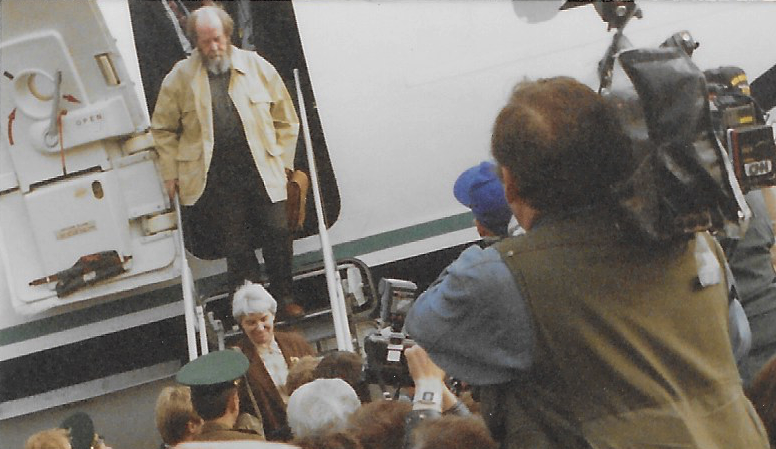
Exhibitions Updates, RFE, RL, VOA
SOLZHENITSYN Target of KGB Propaganda and Censorship by Voice of America
OPINION Cold War Radio Museum How Voice of America Censored Solzhenitsyn SOLZHENITSYN, Target of KGB Propaganda and Censorship by Voice of America By Ted Lipien This research article, written for Cold War Radio Museum website to coincide with the 100th anniversary of the 1917 Bolshevik coup in Russia, deals primarily with censorship at the U.S. taxpayer-funded and government-run Voice of…
OPINION Cold War Radio Museum How Voice of America Censored Solzhenitsyn China, Iran, Cuba, North Korea By Ted Lipien When in 1974 the Voice of America (VOA) banned Alexandr Solzhenitsyn from its programs, the push for the ban may have originated with Secretary of State Henry Kissinger. Today, personal, ideological and partisan preferences of VOA managers and…
OPINION Cold War Radio Museum How Voice of America Censored Solzhenitsyn The Obama “Reset” with Russia By Ted Lipien Hillary Clinton seemed to have had some understanding of how Russian propaganda works when she made her critical comments about the Broadcasting Board of Governors in 2013 to the House Committee on Foreign Affairs, calling the U.S.…
OPINION How Voice of America Censored Solzhenitsyn Radio Liberty Fails on Russian Interference By Ted Lipien The vast majority of political propaganda and disinformation in U.S. media is originated domestically by American commentators, partisan think-tanks, reporters and social media users. But all too often, U.S. government officials, as well as journalists, both government-hired as in the Voice…
Cold War Radio Museum September 17, 2017 On April 13, 1943 Radio Berlin (Reichssender Berlin) broadcast official news of the German Nazi government that German military forces in the Katyn forest near Smolensk, in the then German-occupied region of the Soviet Union, had uncovered a ditch that was “28 metres long and 16 metres wide [92 ft by 52 ft],…
Cold War, Glos Ameryki, History, International Broadcasting, Photo, Poland, Public Diplomacy, Religion, VOA
MSZANA DOLNA NA 150-TĄ ROCZNICĘ NIEPODLEGŁOŚCI STANÓW ZJEDNOCZONYCH
Tadeusz Lipień
4-go lipca Ameryka obchodziła Dzień Niepodległości. Ten szkic ma na celu przypomnienie jak mieszkańcy międzywojennej Rzeczypospolitej obchodzili w 1926 r. w wyjątkowy sposób 150-tą rocznicę podpisania amerykańskiej Deklaracji Niepodległości. Włączyłem do niego także osobiste wspomnienia o moich krewnych i innych mieszkańcach mojej rodzinnej miejscowości Mszany Dolnej, którzy w 1926 r. przesłali specjalne życzenia narodowi amerykańskiemu.

Województwo Lubelskie; Polskie deklaracje szacunku i przyjaźni dla Stanów Zjednoczonych: przedstawiciele województw i okręgów, organizacje prowincjonalne, instytucje wojskowe, organizacje społeczne, wydziały i studenci instytucji akademickich; Tom 2; Kolekcja Biblioteki Kongresowej; 1926 r.
Read in English: “History’s Greatest Fourth of July Birthday Card: A Personal Story of Polish-American Friendship“